En este artículo explicamos cómo la recogida y selección de las aceitunas es una fase decisiva para la calidad del AOVE, ya que influye directamente en su sabor, aroma y propiedades. Detallamos la importancia del momento óptimo de recolección, el estado del fruto y la rapidez en su traslado a almazara, así como la combinación de métodos tradicionales y tecnología para preservar la integridad de la aceituna y garantizar un aceite de oliva virgen extra excepcional.
Harvesting and choosing olives: a crucial step
Jul 31, 2023

Within the production process of quality olive oil, the moment of choosing and harvesting the olives is a key factor for oil mills. At Aceites Ad Morum we carefully measure and work each part of the production process of our liquid treasure to achieve the best flavor and quality of Extra Virgin Olive Oil. Let us tell you all about it!

The harvesting and selection of olives stands out as a fundamental process in the production of olive oil and its quality. This is due to its importance in terms of flavor, quality, and aroma. Therefore, great attention must be paid to this stage, as different factors will serve to obtain an exceptional product in every sense.
The first thing to consider is that to ensure the olives reach the oil mill as quickly and efficiently as possible, optimal and careful harvesting methods must be carried out. This would also imply that the distances between the olive grove and the oil mill are as short as possible.
The harvesting and selection of olives
Discover the key aspects of the process that must be followed to obtain an EVOO of great flavor and quality:
First, you must know in which season of the year the olive harvest takes place. There are some differences depending on the region, climate, and olive variety, but, normally, it takes place between the months of October and January. Likewise, there are multiple factors that determine the quantity and quality of the oil obtained from the olive. Some of them are the health status and maturity of the fruit. The riper the olive, the more oil is obtained, as it concentrates a greater quantity of juice to extract. Conversely, when the olive is still green and less ripe, it is more difficult to extract an abundant quantity of oil. In exchange for that condition, there are certain appreciable benefits in the taste and smell, much more intense and enhanced. Therefore, the harvesting of these green oils, produced at the beginning of the harvest, stand out for their notable flavor and bitter and spicy notes. Thus, they become great enhancers of the flavor of dishes.
The moment to harvest olives
Despite being on the same tree, olives do not necessarily mature at the exact same rate. There are intrinsic and extrinsic factors that determine the transformation each olive undergoes, such as its orientation and hours of sunlight it receives. As you can see, this is not simple at all; it requires knowledge and practice to achieve the correct oil extraction. Control must be maintained at different stages, as all this affects the yield, given the quantity of oil that can be extracted per olive, as well as its quality, which will be marked by its organoleptic qualities, that is, the smell and taste, more or less fruity.
Controlling the olive harvest also influences its content, which can be higher or lower in polyphenols and natural antioxidants. Colder high-mountain areas require a slightly later harvest of the picual olive. Depending on the weather conditions of the year, in mid or late October, the harvest begins with the collection of greener olives to extract the early Picualvariety. Throughout November, slightly riper olives are harvested, from which the envero oil is obtained (formerly considered early, but with current earlier harvests, this becomes slightly later than early).
Olive harvesting methods
The characteristics of the crop, as well as its olive trees, determine the olive harvesting system, from the most traditional to more modern techniques.
Tradition in olive harvesting
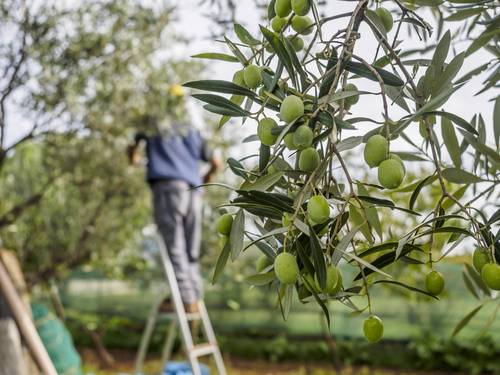
In order to produce an exceptional oil and respecting tradition, olive harvesting is carried out manually. This method is called milking. If teams of olive pickers with nets, poles, and small machinery are used, it is called beating. It is common to have teams of tall olive pickers who beat or pull the nets. Thus, the fruit falls onto a blanket or inverted umbrella.
Mechanized harvesting
Using different vibration methods, which consist of shaking the branches or trunk of the olive tree using machinery. There are branch shakers and shakers that can facilitate the work and allow access to areas that are somewhat more inaccessible for machinery. Other useful machines in highly mechanized fields are sweeper-collectors or vacuum cleaners.
Complementing tradition with technological innovation
Today, tradition is combined with technological innovation, acting in a coordinated manner in the harvesting process. The purpose of this is to avoid damaging this delicate fruit, and therefore, "milking" or manual harvesting is carried out. Following this, they are placed in perforated boxes and transported in containers. Here, the cleaning of the smaller olives begins, along with their branches and leaves.
The next step will be exhaustive control to offer a homogeneous final product. It will be determined which olives are suitable for each elaboration. Once checked and produced, our Picual Variety EVOO will be available and ready for consumption.